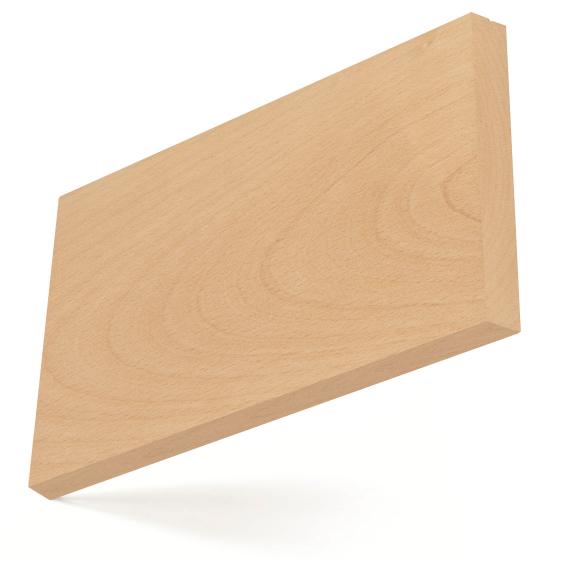
American Beech
Description
● The sapwood of American beech is white with a red tinge, while the heartwood is light yo dark reddish brown.
● American beech tends to be slightly darker and less consistent than European beech.
● The wood is generally straight grained with a close uniform texture.
Distribution & Availability
Grows throughout Eastern USA, although commercial concentration is in the Central and Middle Atlantic States. Production volumes of higher lumber grades and thicker stock may be limited.Durability
Rated as non-resistent to heartwood decay, but permeable for preservative treatment.Working Properties
American beech works readily with most hand and machine tools. It has good nailing and gluing properties and can be stained and polished to a good finish. The wood dries fairly rapidly but with strong tendency to wrap, split and surface check. It is subject to large shrinkage and moderate movement in performace.Main Uses
Furniture, doors, flooring, internal joinery, panelling, brush handles and turning. It is particularly suitable for food containers as there is no odour or taste.Physical & Mechanical Properties
American beech wood is classed as heavy, hard, and reasonably strong, high in resistence to shock and very suitable for steam bending.
| Specific Gravity (12% MC) | 0.64 |
| Average Weight (12% MC) | 721 Kg/m3 |
| Average volumetric shrinkage (Green to 6% MC) | 13.0% |
| Modulus of Rupture | 102.736 MPa |
| Modulus of Elasticity | 11,859 MPa |
| Compressive strength (parallel to grain) | 50.334 MPa |
| Hardness | 5782 N |